|
Restaurant business is tough, we do agree. But, a successful venture return money, a lot of money. Question, is how to analyze your business success? With Lean Six Sigma, a defined approach can be applied for further evaluation.
Let’s start with understanding the customers, where do they come form, in what shape & thought. I will divide this in two aspect: External Customer & Internal Customer. External Customer: This are the customer, who step in your restaurant from front door. They pay for food, services, ambiance, entertainment etc Internal Customer: This are the employee, chef & server. Very important aspect for your restaurant success. Their happiness/ satisfaction are being transfer to external customer. A simple technique is to measure, how do your customer rate your business? Key point, is data. Where you can find data? Example are at Yelp review, google review, your website review etc Collect all the reviews provided by your external & internal customer. Select some factor critical to business, say Food, Service, Entertainment etc. Assign each factor with 3 aspect. Good, OK & BAD. Start reading review, create a table which is often in six sigma term known as Critical to X / Voice of Customer, you can say Critical to Restaurant & rate them. (Food – Good – 10) means, in your review 10 people mention food is good or best. Like wise collect all the data from different channel. Now, analyze them, say, 10 people comment food is good, 3 mentioned food is OK & 1, food is bad. Same , 10 say Service is good, 14 say service is OK & 5 say service is Bad. Here, you should be more worried about service than food. As it has more weight. Think of factor associated with service? Customer has to wait for food? or Staff was not friendly, further, read customer review, try to see if you can link more factor. This technique is known as decision tree. You are going deep into solution. After you learn all the factor. It’s time for Improve. Improvement may require money, reward to employee, special attention to small stuff. Say, if customer has to wait for food, adding one more staff can be good idea during busy hours or while customer, is waiting, adding a snack item for free on table can overcome service point or a system where chef know a customer order the food 5 min before to take on priority. This improvement are again part of thoughtful observation & feedback. Last would be to Control the entire process for consistency. Once you set some bar, make sure to follow them. It was easy right. You only need to familiar yourself with six sigma techniques & tools.You can learn many topic for free at our site. Do let us know, if we can be any help? Enjoy. I had listed some link for you. You can understand more what Critical to X means, Tree Diagram.
1 Comment
Poke Yoke, is a concept of making sure there are no mistakes in process/services. Poke Yoke, is often known as “mistake proof”. Let me start here with very simple example: In kitchen, there are two tab for water. One is for hot and other is for cold. If nothing is mark or mention on them, then it may happen, one of your guest open hot water tab & may feel quick discomfort while washing his/her hands. How can you make sure, this simple activity as mistake proof ? Answer is Poke Yoke. By marking, Hot tab with Red color / Blue with Cold, signify the difference. 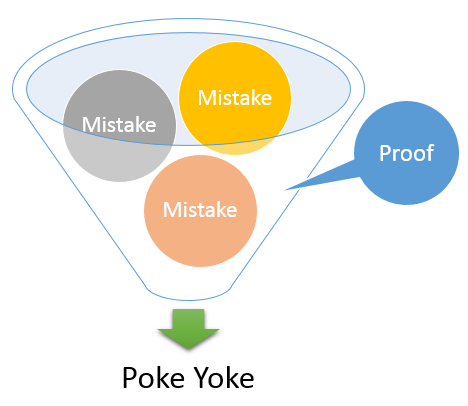 Industry or company, learn this kind of activity through a concept of poke yoke thereby delivering mistake proof product/ service to consumer. This concept develop into standards which are adopted by other companies.
Poke Yoke is associated with cost of quality. If you can’t “mistake proof ” the process, it will result in loss of money. Below are few more example: -If a customer, is returning more product then there is something wrong with your process. Use Poke yoke tactics to make sure it’s mistake proof. -If lot of people are unsubscribing your newsletter then there must be something wrong with your content, design etc. If you talk about defect. I will say Poke yoke, is the father of defect. Learning this important tactics might save some money. It’s very simple. You just need to make yourself familiar with the way it work. Explore more about Poke Yoke ” mistake proof Judgment Inspection Informative Inspection Successive Check Self Check Source Inspection Poke Yoke Systems Control Warning Mistake proof” at below wiki link: POKE YOKE TACTICS “Human errors can occur in many ways. Any operation that relies on the human element will run into the problem of errors. The notion of concentrating 100% of the time on a task will not guarantee zero defects in the product. Poka-yoke is the Japanese term for “mistake-proofing” or “fail-safing” a task. Poka-yoke devices can be installed at low costs.” Six Sigma Benefit
Eliminate Variability & Improve Quality •Data Collection/Measure Analysis •DMAIC Project Flowchart •Tie Project to Business Metrics Lean Benefit Identify & Eliminate Process Waste •Improve Process Flow and Efficiency •Develop low cost, simple, agile processes Comparison of Six Sigma and Lean Improvement Six Sigma : Reduce variation / Lean : Reduce Waste Justification Six Sigma : Six Sigma Quality (3.4 DPMO) / Lean : Speed (velocity) Main Saving Six Sigma : Cost of Poor Quality / Lean : Operating Costs Learning Curve Six Sigma: Long / Lean : Short Project Selection Six Sigma: Various approaches / Lean : Value Stream Mapping Project Length Six Sigma : 2-6 Month / Lean : 1 week -3 month Driver Data Demand Six Sigma: Complexity / Lean : High Moderate When to execute Lean If major business problems are: •There seems to be a lot of wastes •There is a need to minimize inventories and redundancies •There is a need to improve work flows •There is a need to speed p processes •There are human mistakes Then, Lean techniques can be used to: •Eliminate wastes •Simplify processes •Increase speed •Improve flows •Minimize inventories •Mistake proof processes When to execute Six Sigma If major business problems are: •There are quality issues •There is excessive variation •There are complex problems •There are challenging root cause identifications •There are numerous technical considerations Then, Six Sigma techniques can be used to: •Minimize variation •Apply scientific problem solving •Utilize robust project chartering •Focus on quality issues •Employ technical methodologies Welcome to Six Lean Sigma Blog, today we are going to discuss a very interesting case study about Hot Rolling Mill. Rolling mill, are machines, which roll aluminum utilizing combination of force and temperature. In this classic example, i will describe scope of Six Sigma ( Mult- Vari Study).
First of all what is Multi-Vari Study? Let me start with a very simple example from daily life. Say, you have a laptop & you are working on it from past 3 hours. One of you might notice heat produce by your laptop. Thus, measure of heat represent, temperature. We can say temperature is one of the factor associated with Heat. Now, let’s see how temperature can vary: 1. It can vary from one point to other point, across length of laptop. 2. It can vary from time to time. When you switch on, temperature was low and after 3 hour temperature is little high. 3. It can vary from laptop to laptop. HP, is heating up more than Apple. If we wanna solve problem of laptop heating, we can investigate the stability or consistency of a laptop with Multi Vari Study. Multi Vari chart consists of a series of vertical lines, or other appropriate schematics, along a time scale. The length of each line or schematic shape represents the range of values found in each sample set. I hope, it’s clear now what is Multi Vari Study. Let’s look at our case study: Six Sigma Case Study based on Multi Var Study A manufacturer produced flat sheets of aluminum on a hot rolling mill with a thickness specification was 0.245″ to.005″. A process capability study indicated that the process spread was 0.0125″ (a Cp of 0.8) versus the requirement of 0.010″. The operation generated a profit of approximately $200,000 per month even after a scrap loss of $20,000 per month. Refitting the mill with a more modern design, featuring automatic gauge control and hydraulic roll bending, would cost $800,000 and result in 6 weeks of downtime for installation. The department manager requested that a multi-vari study be conducted by a quality engineer before further consideration of the new mill design or other alternatives. Four positional measurements were made at the corners of each flat sheet in order r to adequately determine within piece variation. Three flat sheets were measured in consecutive order to determine piece to piece variation. Additionally, samples were collected each hour to determine temporal variation. The results of this short term study were slightly better than the earlier process capability study. The maximum detected variation was 0.010″. Without sophisticated analysis, it appeared that the time to time variation was the largest culprit. A gross change was noted after the 10:00 AM break. During this time, the roll coolant tank was refilled. Actions taken over the next two weeks included re-leveling the bottom back-up roll (approximately 30% of total variation) and initiating more frequent coolant tank additions, followed by an automatic coolant make-up modification (50% of total variation). Additional spray nozzles were added to the roll stripper housings to reduce heat build up in the work rolls during the rolling process (10-15% of total variation). The piece to piece variation was ignored. This dimensional variation may have resulted from roll bearing slop or variation in incoming aluminum sheet temperature (or a number of other sources). The results from this single study indicated that, if all of the modifications were perfect, the resulting measurement spread would be 0.002″ total.In reality, the end result was : +/-0.002″ or 0.004″ total, under conditions similar to that of the initial study. The total cash expenditure was $8,000 for the described modifications. All work was completed in two weeks. The specification of 0.245″ +/-0.005″ was easily met. Most multi-vari analysis does not yield results that are this spectacular, but the potential for significant improvement is apparent. You can learn more about Multi Vari Study from our wiki page here I will start this case study with a quote by Kofi Annan ” Knowledge is power. Information is liberating. Education is the premise of progress, in every society, in every family.” Same saying is applicable to this case study of Digital Six Sigma. Setting up digital website and quality content is one of the way, where you can impart lean six sigma knowledge.
What does it take to turn a company with six very autonomous and competitive sectors, each accustomed to driving its own business and initiatives, into one collaborative team sharing the same goal? With the objective of driving overall profitability, Motorola brought together leaders from each of the company’s business units to share best practices, improve profitability, and achieve US$3 billion in cost reduction within three years through its Digital Six Sigma initiative. Challenge Operating within a decentralized environment, Motorola has always given each of its sector leadership teams a great deal of independence in how they run their businesses. However, the success of Digital Six Sigma was dependent upon company wide buy-in and collaboration, and this long history of autonomy became the first challenge the organization needed to overcome. SOLUTION Motorola then invited the Cisco Systems® Internet Business Solutions Group (IBSG) consultants to work with the teams on the customer care process. “They helped us conduct an assessment to discover where each sector was in terms of self-service capabilities,” explains Karen Hamilton, senior director, Personal Communication Sector, Service and Support at Motorola. “We took a look at what we already had on the roadmap vs. what we weren’t even thinking about yet and identified strengths, weaknesses, and opportunities.” The IBSG assessment identified three critical areas of focus within customer care—business-to-business (B2B) support, B2B field service, and business-to-consumer (B2C) support. The Cisco IBSG consultants also demonstrated how Motorola could take advantage of networking and Web tools in the areas of service and support to implement automated contract management, software downloads, updated product specifications, and requirement gathering for remote monitoring and support. “Cisco put us on the right path, solidifying clarity around our roadmaps, bringing a structured view as to how to go about this, and accelerating the implementation of the initiative,” Hamilton says. IMPROVE Opportunities being pursued include: • B2B support—Automation of key process areas to reduce costs, including case management, remote diagnosis and resolution, and software downloads • B2B field service—Use of Web-based tools to support revenue growth as well as cost reduction in the service and support business area through product redesign that can enable remote monitoring and service • B2C support—Increased revenue opportunity through improved customer support, which also serves to increase customer loyalty and customer lifetime value RESULTS As of November 2004, Motorola is ahead of schedule in reaching its original goal of US$3 billion in cost savings within three years from its Digital Six Sigma effort. About halfway through the initiative, the company has already saved US$1.8 billion, much of that coming from improved engineering productivity, reduced cost of poor quality (CoPQ) and increased procurement effectiveness. The team is on track to hit the third billion over the next 12 months. Follow link for more info. Link Case Study is a particular instance of something used or analyzed in order to illustrate a thesis or principle. We will also list, summary from case studies which will guide you “How Lean Six Sigma is implemented in real World”. Stay tuned for exclusively case study page at:
Case Study Also, we had added, Job section today. All job associated with Lean Six Sigma will be listed on right hand side. Smart page engine, automatically, seek your IP address and list job from your city and State. Stay tuned guys ! We will nurture you in all the ways. One neat & clean platform. No ads, nothing. Quality Content. Kaizen, is a topic under Lean. It is usually referred to as incremental improvement but on a continuous basis and involving everyone.
Kaizen is Japanese for continuous improvement . Kai means Change Zen means Good or For the Better The Kaizen strategy involves:
PDSA – plan do study act or plan do study adjust
Lean can be defined as elimination of waste. In manufacturing term, it can be list as below:
Very simple, 8 point answer:
*(DMAIC)-Define, Measure, Analyze, Improve & Control AIM
Everything is a process. In business world, there are only products and processes, actually, products are also processes, because the product usage is also a process. Do the right thing, design the right product, the right process and do things right, Consistent product, consistent process. Sigma Sigma-the lower case Greek letter that denotes a statistical unit of measurement used to define the standard deviation of a population. It measures the variability or spread of the data. |
 RSS Feed