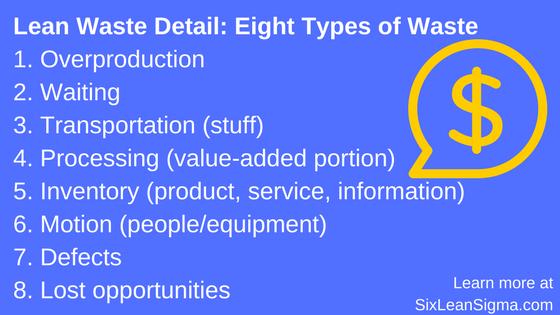
Lean Waste Detail: Eight Types of Waste
1. Overproduction
2. Waiting
3. Transportation (stuff)
4. Processing (value‐added portion)
5. Inventory (product, service, information)
6. Motion (people/equipment)
7. Defects
8. Lost opportunities
Waste ‐ Overproduction
• Making things you can’t sell now
• Taiichi Ohno saw overproduction as the root of
all manufacturing evil.
• Related costs:
– Building and maintenance of warehouse space
– Extra works & machines
– Extra parts and materials
– Extra energy
– Extra material handling equipment
– Extra interest payments on loans
– Other hidden problems & invisible Kaizen points
• Can be the root cause of other kinds of waste:
– Motion: working are busy making things that no body ordered
– Waiting: related to large batch sizes
– Conveyance: goods must be moved to storage locations
– Correction: not easy to spot defects
– Inventory: creates purchasing unnecessary raw
materials, parts, and WIP
Waste – Waiting (Delay)
• Occurs when a worker has to wait for materials or a line stoppage to be cleared
• Occurs when there is excessive WIP due to large batch production, equipment problems or defects
• Increases lead time
• Lead time = Processing time + Retention time
• Retention time can far exceed processing time
Waste – Transportation (Conveyance)
• Caused by:
– Inefficient work place layout
– Overly large equipment
– Batch production
– Can also be caused on a micro level for in‐station activities
• Conveyance, delay and motion wastes are closely related
• Necessary muda but must be minimized
Waste – Over Processing
• A subtle form of muda related to doing more than what the customer is willing to pay for.
• Often seen in companies driven by engineering departments which are driven by technology improvements
Waste – Inventory
• Product, service, information
• Keeping unnecessary raw materials, parts, or WIP
• Can be caused by products or services not linked to the drumbeat of the customer or when flow is interrupted
• MRP can cause this as it is a push system
• Making ‘extra’ just in case
Waste – Motion
• People & equipment element
• Poor ergonomics, unnecessary walking, reaching or twisting; can also be a safety issue
• Equipment placed too far from each other; poor work place design
Waste – Correction (Defects)
• Rework on defective products or services
• Extra: manpower, energy, parts, time & cost (especially due to quality & scrap costs)
Waste – Knowledge Disconnection (Lost Opportunities)
• Can exist within a company, between
companies and/or with suppliers
• Horizontal, vertical or temporal
• Typically inhibits the flow of knowledge, creativity
• Can be a source for frustration and missed opportunities
• Disconnects with the customer can lead to the loss of quickly identifying all sorts of muda
Lean is Not Just About Waste Removal
• Must continually seek ‘Continuous Flow’
• Must seek ‘Stability’ throughout the organization
• Must employ a system of ‘Visual Management’
• Must involve the entire workforce in continuous improvement
Other Causes of Waste
• Lack of communication
• Inadequate training
• Inconsistent work practices
• Ineffective policies and procedures
• Incorrect processing
• Poor layouts
• Excessive inventory
• Lack of workplace organization
Waste Results in…
• Extra • Wasted Resources
– Space
– Equipment
as ed esou ces
– People
– Material
– Manpower
– Storage and Handling
• Long Lead Times
– Environmental / pollution
• Poor Customer
Satisfaction
• Bottlenecks
• Increasing Overtime
– Quality
– Cost
• Firefighting – Delivery
• Stress
2. Waiting
3. Transportation (stuff)
4. Processing (value‐added portion)
5. Inventory (product, service, information)
6. Motion (people/equipment)
7. Defects
8. Lost opportunities
Waste ‐ Overproduction
• Making things you can’t sell now
• Taiichi Ohno saw overproduction as the root of
all manufacturing evil.
• Related costs:
– Building and maintenance of warehouse space
– Extra works & machines
– Extra parts and materials
– Extra energy
– Extra material handling equipment
– Extra interest payments on loans
– Other hidden problems & invisible Kaizen points
• Can be the root cause of other kinds of waste:
– Motion: working are busy making things that no body ordered
– Waiting: related to large batch sizes
– Conveyance: goods must be moved to storage locations
– Correction: not easy to spot defects
– Inventory: creates purchasing unnecessary raw
materials, parts, and WIP
Waste – Waiting (Delay)
• Occurs when a worker has to wait for materials or a line stoppage to be cleared
• Occurs when there is excessive WIP due to large batch production, equipment problems or defects
• Increases lead time
• Lead time = Processing time + Retention time
• Retention time can far exceed processing time
Waste – Transportation (Conveyance)
• Caused by:
– Inefficient work place layout
– Overly large equipment
– Batch production
– Can also be caused on a micro level for in‐station activities
• Conveyance, delay and motion wastes are closely related
• Necessary muda but must be minimized
Waste – Over Processing
• A subtle form of muda related to doing more than what the customer is willing to pay for.
• Often seen in companies driven by engineering departments which are driven by technology improvements
Waste – Inventory
• Product, service, information
• Keeping unnecessary raw materials, parts, or WIP
• Can be caused by products or services not linked to the drumbeat of the customer or when flow is interrupted
• MRP can cause this as it is a push system
• Making ‘extra’ just in case
Waste – Motion
• People & equipment element
• Poor ergonomics, unnecessary walking, reaching or twisting; can also be a safety issue
• Equipment placed too far from each other; poor work place design
Waste – Correction (Defects)
• Rework on defective products or services
• Extra: manpower, energy, parts, time & cost (especially due to quality & scrap costs)
Waste – Knowledge Disconnection (Lost Opportunities)
• Can exist within a company, between
companies and/or with suppliers
• Horizontal, vertical or temporal
• Typically inhibits the flow of knowledge, creativity
• Can be a source for frustration and missed opportunities
• Disconnects with the customer can lead to the loss of quickly identifying all sorts of muda
Lean is Not Just About Waste Removal
• Must continually seek ‘Continuous Flow’
• Must seek ‘Stability’ throughout the organization
• Must employ a system of ‘Visual Management’
• Must involve the entire workforce in continuous improvement
Other Causes of Waste
• Lack of communication
• Inadequate training
• Inconsistent work practices
• Ineffective policies and procedures
• Incorrect processing
• Poor layouts
• Excessive inventory
• Lack of workplace organization
Waste Results in…
• Extra • Wasted Resources
– Space
– Equipment
as ed esou ces
– People
– Material
– Manpower
– Storage and Handling
• Long Lead Times
– Environmental / pollution
• Poor Customer
Satisfaction
• Bottlenecks
• Increasing Overtime
– Quality
– Cost
• Firefighting – Delivery
• Stress